






DRE#01495981
Blog
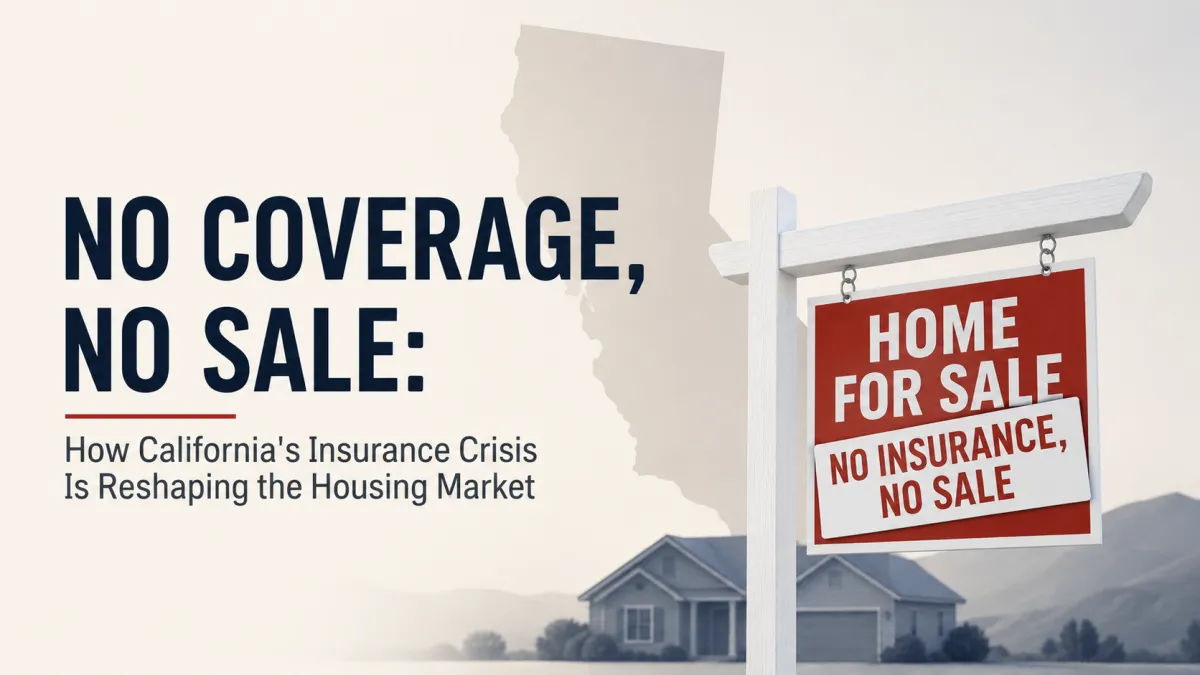
No Coverage, No Sale: How California's Insurance Crisis Is Reshaping the Housing Market
If you've been paying attention to the California home insurance crisis 2026, you already know things have gotten complicated. Really complicated. What used to be a background item on the closing checklist has become a deal-breaker that can kill a transaction weeks in, sometimes days before close of escrow. Buyers, sellers, and even agents who have been doing this for years are getting caught off guard.
This post breaks down what is actually happening, why it matters whether you are buying or selling, and what you can do about it before it costs you a deal.
Why Homeowners Are Losing Coverage and What Triggered This Mess
Let's go back a few years. After the 2017 and 2018 wildfire seasons, major insurers started quietly pulling back from California. Then came the 2021 Dixie and Caldor fires. Then the 2023 losses. By the time the Los Angeles fires hit in early 2025, several of the biggest names in home insurance had already stopped renewing policies across wide swaths of the state.
The result? Hundreds of thousands of California homeowners insurance dropped notices arriving in mailboxes. Not just in mountain communities or rural areas. We are talking about neighborhoods in the foothills, parts of the San Fernando Valley, areas of the Santa Monica Mountains, and yes, parts of Orange County and Los Angeles County that nobody would have called "high risk" five years ago.
The California insurance market collapse did not happen overnight, but it accelerated faster than most homeowners were prepared for. State Farm, Allstate, Farmers, and others scaled back or stopped writing new policies entirely. When the private market pulls out, people turn to the last resort option. Which brings us to the FAIR Plan.
What the California FAIR Plan Actually Is (And What It Is Not)
If your current insurer dropped you or you cannot get coverage on a new purchase, you have probably heard about the California FAIR Plan insurance option. Here is what you need to understand: it is a shared market of last resort, not a true replacement for a standard homeowners policy.
The FAIR Plan covers fire and a few other perils, but it does not cover liability, theft, water damage, or a number of other things a standard policy would. Most lenders require a standard policy or a FAIR Plan policy combined with a "Difference in Conditions" wrap policy, which adds back some of the missing coverage. That combination can get expensive fast.
Premiums on the FAIR Plan have increased significantly, and as of 2026, the plan itself has been under financial pressure due to the volume of claims from the Los Angeles fires. This is not a comfortable backup. It is a band-aid on a system that is straining under the weight of climate risk.
For buyers, understanding property insurance availability California-wide, and specifically for the neighborhood they are shopping in, is now as important as understanding property taxes or HOA fees.
How the Insurance Crisis Is Affecting Real Estate Transactions Right Now
Here is where this gets practical for anyone buying or selling.
For sellers, the question of home insurability California wildfire risk has become part of the pre-listing conversation. If your home sits in a high fire hazard severity zone (FHSZ), you need to know that before a buyer falls in love with it. Buyers are now walking away not because of the price or the condition of the home, but because they cannot find a lender-acceptable insurance policy. That is a different kind of problem and it can blindside sellers who never thought about it.
Homes in parts of Altadena, Arcadia, Sierra Madre, and the hillside communities east of Pasadena have seen this firsthand. The wildfire insurance real estate impact in those areas has been dramatic. Some well-priced listings sat for months because insurer after insurer declined to write coverage.
For buyers, the California real estate insurance contingency has become one of the most important clauses in a purchase agreement. Traditionally, buyers have a financing contingency and an inspection contingency. Now smart buyers are adding an insurance contingency or at minimum making sure they can secure coverage before removing contingencies.
If you are buying a home in California, insurance problems can surface at any point in the escrow process. I have seen buyers get a quote, proceed through inspections, and then get denied when the insurer actually ran the property address through their underwriting system. That is a stressful situation that could have been avoided with a little early legwork.
The practical advice: contact insurance brokers early. Before you make an offer if possible, or at minimum within the first few days of your inspection period. Get actual quotes, not estimates. Find out whether the property is in a FHSZ and whether any prior claims on the property show up in the CLUE report.
Uninsurable Homes: The New Reality Nobody Wants to Talk About
There is a term that has started showing up more in real estate circles: uninsurable homes California. It refers to properties where no private carrier will write coverage and the FAIR Plan is either unavailable at a rate that makes the purchase viable, or insufficient to satisfy the lender.
These properties exist. They are on the market. Some sellers do not know their home falls into this category until a buyer's insurance agent tells them.
For cash buyers, technically you can purchase an uninsurable home. No lender means no insurance requirement. But that creates real problems for resale, and it means you are personally absorbing all the fire risk. That is not a position most buyers want to be in.
The home insurance wildfire risk Los Angeles zone issue has made this especially acute in the areas affected by the January 2025 fires. Properties in and around Pacific Palisades, Altadena, and parts of the hills above Pasadena have seen buyer pools shrink dramatically, not because of price, but because of insurability.
What Orange County Buyers and Sellers Should Know
Orange County is not immune. Parts of Anaheim Hills, portions of the Irvine foothills, communities near the Cleveland National Forest, and areas of South Orange County near Laguna Beach and Mission Viejo have elevated fire hazard designations. The California home insurance crisis 2026 is not a story that only affects Northern California or the mountains. It is here.
If you are buying a home in California, insurance problems can show up even in areas that feel suburban and settled. A property on the edge of open space in Rancho Santa Margarita or backing up to brushland in Yorba Linda can face the same insurer hesitation as a cabin in the mountains.
Sellers in these areas need to be prepared for buyers asking more insurance-related questions than ever before. Some buyers will ask for documentation showing the current coverage, the premium, and whether the policy can be transferred or whether they need to find their own. Having that information ready speeds up escrow and demonstrates you know what you are doing.
So What Do You Do? Practical Steps for Buyers and Sellers
If you are a buyer:
Start your insurance search early. Get quotes on specific addresses before you get emotionally attached to a property. Ask your agent to help you identify the fire hazard severity zone designation before making an offer. Build an insurance contingency into your purchase agreement. If the FAIR Plan is the only option, run the numbers fully before proceeding.
If you are a seller:
Pull your current policy and know what it costs and what it covers. If your home is in an elevated fire risk area, consider getting quotes proactively so you can present them to serious buyers. Make any fire-hardening improvements you can. Clear brush, check your vents, document it. Some insurers are coming back into the market for properties that have taken mitigation steps, and showing that documentation can make a difference.
For everyone:
Work with people who know this market and are paying attention. The California home insurance crisis 2026 is not a static situation. The regulatory environment has been shifting, new legislation was passed in 2024 allowing insurers to factor in forward-looking climate risk models into their pricing, and some carriers are beginning to re-enter the market in limited ways. But it is moving slowly. For now, property insurance availability California-wide is still constrained, and that affects deals.
How Homes By Heiddith Helps Clients Navigate This
Heiddith Panelo has been a licensed Realtor in Orange County and Los Angeles County since 2005. Over 20 years of transactions means she has seen markets shift in ways that catch people off guard, and the California home insurance crisis 2026 is one of the bigger structural shifts she has watched develop in real time.
"The clients who come in prepared are the ones who get through escrow without the last-minute panic," Heiddith says. "Insurance is not a footnote anymore. We talk about it at the start of every conversation now."
Working with Homes By Heiddith means having someone in your corner who knows which neighborhoods are facing the steepest buying a home in California insurance problems, which areas are seeing carriers return, and how to structure an offer that protects you if the insurance picture changes during escrow. Heiddith is bilingual in English and Spanish, which matters when you are navigating complex documentation and want to make sure nothing gets lost in translation.
Whether you are a first-time buyer trying to understand the California FAIR Plan insurance option or a seller wondering how home insurability California wildfire designations might affect your sale price, the first step is a conversation. Heiddith offers a free consultation and there is no pressure, no sales pitch, just real information from someone who knows this market.
Call (714) 615-0579 or visit homesbyheiddith.com to get started.



Share
Pin it
Homes By Heiddith
HEIDI PANELO | DRE #01495981
14615 Magnolia Street
Westminster, CA 92683
Email us: [email protected]
Phone: (714) 615-0579
Like Us
Like Us
Our love for the communities we live and work in are why we do what we do. Stop by the office and experience the Homes By Heiddith way of Orange County area real estate.
© 2026 Homes by Heiddith
DRE#01495981